


A lot of campaigns get labeled “creative” because they look polished or use a clever line. But that’s not what makes a campaign break through.
Breakthrough happens when the work has a clear point of view, a focused promise, and execution that’s confident enough to be simple.
7 Steps for Creative Campaign Development and Execution
The best creative campaigns go through a clear lifecycle, moving from idea generation and messaging alignment to execution and measurement. Develop your creative campaign strategy and concept with these seven tips:
#1: Start With The One Thing
Before you brainstorm visuals, taglines, or channels, you have to decide what the brand stands for. A brand can only be one thing, if you want to be remembered.
That’s why certain brands become mental shortcuts. Volvo is safety. Harley-Davidson is freedom. In the car market, Toyota and Honda are the safe bet, Volkswagen brings personality, Porsche owns performance, and BMW is performance with kids.
You can debate details, but you can’t miss what each brand is trying to own. In the same way, your creative campaign strategy should start with picking the central thing your brand will stand for.
- Decision To Make: What is the single territory this campaign reinforces?
- If You Skip This: You’ll end up with buffet thinking, trying to include something for everybody, and the work will feel broad instead of sharp.
#2: Define The Tension You’re Solving
Once the “one thing” is clear, the next question is what tension the customer is living with right now. This is where campaigns stop being clever and start being relevant.
There are usually three layers of tension, and the strongest creative campaign strategies understand all three:
- Functional tension: What isn’t working or what’s too hard right now?
- Emotional tension: What does that problem make them feel?
- Social tension: What do they want to avoid looking like?
Liquid Death is a clear example. The campaign isn’t really about water. It’s about the social tension of not wanting to drink alcohol, but also not wanting to stand at a party holding a plastic bottle and feeling awkward.
So they created a “bad boy” water in a tall boy can. Now you can opt out without having to explain yourself. The product becomes a social solution.
- Decision To Make: What is the real problem your customer wants to make go away, including the social one?
- If You Skip This: You’ll default to talking about yourself, features, process, and “what we do,” which is rarely what people buy.
#3: Write The Campaign Opinion
If you want to break through, you can’t sound like the category. You need an opinion. Not a hot take for the sake of it, but a clear stance that makes the message feel intentional.
This step is also where you kill the instinct to copy the category leader. When smaller brands mimic the biggest brand’s messaging, they don’t borrow credibility. They end up marketing the biggest brand for free.
If your product is “like Lego,” the customer’s natural conclusion is to go buy Lego.
Dollar Shave Club didn’t try to out-Gillette Gillette. They walked into a commoditized category and had a straightforward opinion: razor marketing is inflated nonsense, and you’re paying for features you don’t need.
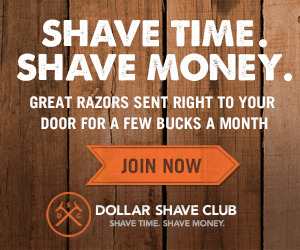
With this opinion backing their physical and digital creative campaigns, they gave people a simpler alternative and wrapped it in a stance people could identify with.
- Decision To Make: What do you believe the category usually avoids saying out loud?
- If You Skip This: Your campaign will look and sound like everybody else, and it won’t matter how good the design is.
#4: Translate Strategy Into A One-Sentence Concept
Your creative campaign strategy is the reasoning, the audience tension, and the position you’re trying to own. In contrast, the concept is the unifying idea that turns that strategy into something people can instantly recognize.
If you can’t express the concept in one sentence, you’re not ready to execute. You’re still in strategy. The one sentence forces focus and keeps you from cramming multiple promises into the work.
A simple format that keeps you honest is:
If [tension], then [brand] is the [unexpected answer], because [opinion].
Dollar Shave Club, for example, takes a messy decision and turns it into a simple alternative you can repeat.
Liquid Death takes the awkwardness of choosing water at a party and turns it into a confident signal that you still fit the vibe.
That’s what a concept does. It gives your particular audience a clean takeaway, fast.
- Decision To Make: What is the campaign’s core idea in one sentence?
- If You Skip This: Execution becomes overstuffed because you’ll try to make the ad explain what the concept should have clarified.
#5: Choose The Proof Device That Makes The Idea Obvious
Once you have a concept, you need to choose a proof device. This type of device is the main vehicle that makes your concept feel believable and instantly recognizable without extra explanation.
Most campaigns get noisy because they don’t have a proof device, so they compensate with more copy, more claims, more badges, more explanation.
Common proof devices include:
- Visual device: a consistent framing or visual language
- Product device: the product itself becomes the symbol
- Behavior device: a signature action or offer that reinforces the stance
- Language device: a repeatable phrase or framing that people associate with you
British Airways provides a great example of a visual proof device. Instead of the usual travel clichés, they used a simple passenger point-of-view image out the plane window, with subtle branding reflected on the aircraft.

Notice how there’s no headline, no body copy, and no URL? The image does the work. You feel where you’re going, you understand who gets you there, and the brand is present without yelling.
- Decision To Make: What is the single device that carries the concept instantly?
- If You Skip This? You’ll add more “stuff” to try to make the audience understand, and the campaign will lose its punch.
#6: Set Execution Rules So You Don’t Overstuff The Work
Once you have a concept and a proof device, execution becomes simpler. Your job is to keep it clean enough that the idea can hit in a couple of seconds.
Setting execution rules is where restraint becomes a strategy, not just a design preference.
A useful way to lock execution is to define three rules:
- What gets removed: Extra promises, extra copy, extra CTAs, clutter
- What category norm gets broken: The one convention you refuse to follow
- What the audience must feel quickly: Relief, rebellion, belonging, aspiration, confidence—something good they’ll want again and again.
British Airways removed most of the typical “marketing furniture” because they trusted the audience. People know how to look things up. They don’t need instructions everywhere. They need a reason to remember you.
- Decision To Make: What are the three execution rules that protect clarity?
- If You Skip This? The work will drift back into buffet thinking, and the message will weaken.
#7: Measure What Matches The Job, Then Tighten Instead Of Broadening
A campaign’s job isn’t always immediate conversion. Sometimes the job is to reinforce the territory you want to own and make the brand easier to choose later.
That’s why measurement should match intent:
- If the campaign is about positioning, you care about recall, brand search lift, saves and shares, sentiment, and message pull-through.
- If the campaign is about response, you care about CTR, conversion rate, CAC, demos, trials, and revenue.
The key is how you react to data. When teams see early performance and immediately broaden the message, they usually drift into sameness. A better move is to tighten around the original idea.
If people don’t stop, the problem is likely due to execution.
If they stop but don’t act, it’s usually because the value proposition or next step isn’t clear enough, the offer isn’t compelling enough, or there’s too much friction or anxiety in the action.
If they act but don’t stick, it’s the product or expectation.
- Decision To Make: Are we measuring proof of territory, proof of response, or both?
- If You Skip This? You’ll optimize the campaign into blandness because the safest messages often win short-term metrics.
Creative Campaign Development Checklist
To keep your creative campaign focused, use the following questions to pressure-test a campaign before it goes out the door:
The “One Thing”
- What territory does your brand own, alone?
The Tension
- What functional, emotional, and social tension are we solving?
The Opinion
- What do we believe that the category avoids saying?
The Concept
- What is the idea in one sentence?
The Proof Device
- What carries the idea instantly, without explanation?
The Execution Rules
- What gets removed, what norm gets broken, and what must be felt quickly?
The Measurement Plan
- What does success look like for positioning vs response, and what will we tighten if it underperforms?
Develop Your Creative Campaign Strategy With BrandBossHQ
Ready for your brand to break through the the noise and claim its own territory? BrandBossHQ can help. With our creative campaign services in your corner, you can feel confident that your creative campaign isn’t just copying the rest and fading into the background.
Review our creative campaign services today. If you’re ready to stake out your territory, please schedule a consultation.

.png)


